
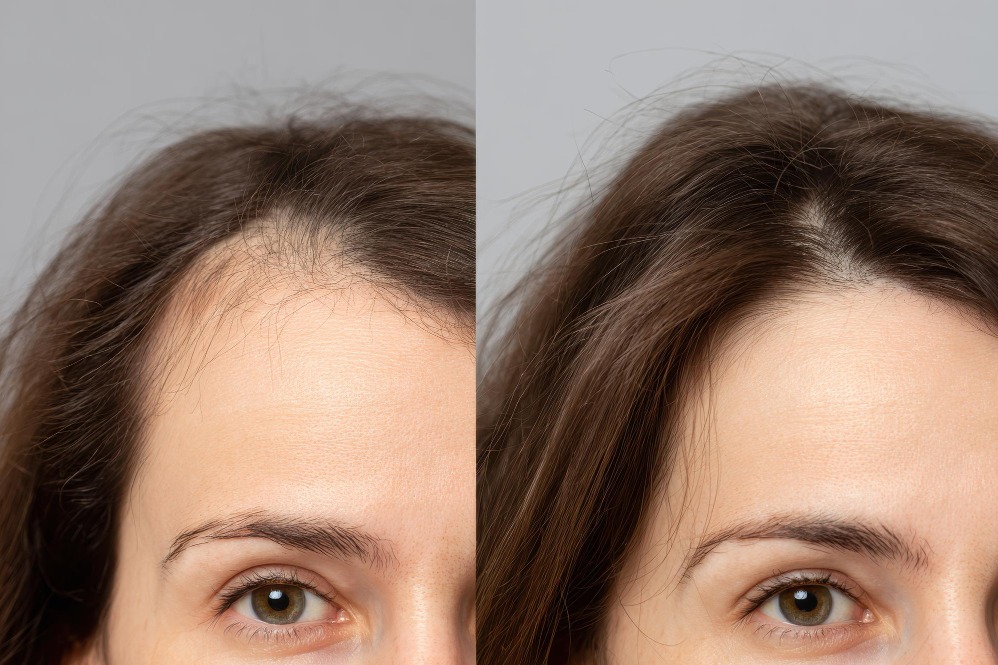
Noticing a wider parting, reduced ponytail volume, visible scalp, or gradual thinning can be concerning. It can also make people vulnerable to treatments promising rapid regrowth or dramatic increases in density.
Before choosing hair density improvement therapy, it is important to establish why the density has changed.
For patients in Airoli and the wider Maharashtra region, a provider should be able to explain the assessment, treatment rationale, realistic timeline, and limitations before therapy begins.
Start with the Pattern of Hair Loss
'Low hair density' is a description, not a diagnosis.
Thinning may be diffuse across the scalp, concentrated in particular areas, occur in patches, or follow a recognizable pattern. Some people primarily experience increased shedding rather than progressive miniaturisation or permanent loss.
These differences influence what treatment can reasonably accomplish.
Ask Whether Further Evaluation Is Needed
A clinical history and scalp examination may provide substantial information, but investigations can sometimes be considered depending on the pattern and suspected contributing factors.
A good provider should be able to explain why a test is or is not being recommended rather than automatically offering the same investigation package to everyone.
Compare Therapies by Evidence and Suitability
Patients may encounter topical treatments, oral medicines, scalp procedures, injectable approaches, devices, supplements, and cosmetic products marketed for density improvement.
Do not evaluate them purely by popularity.
Instead, ask four questions:
- What type of hair loss is this intended to address?
- Why is it appropriate for my pattern?
- What evidence supports its use?
- What are the risks, limitations, and maintenance requirements?
A treatment can be legitimate yet still be unsuitable for a particular person.
Be Realistic About the Timeline
Hair growth is slow.
Treatments aimed at reducing shedding or supporting density generally cannot be evaluated meaningfully after only a few days. Depending on the diagnosis and therapy, monitoring may occur over months.
Be cautious about providers promising dramatic new hair growth within an implausibly short period.
Before-and-After Photographs Need Consistency
Hair photographs can be misleading when lighting, angle, hairstyle, hair length, wetness, or camera settings differ.
If progress photographs are being used, consistency improves their usefulness.
Objective monitoring is particularly valuable because gradual changes can be difficult to judge from memory.
Ask About Maintenance Before You Start
One of the most overlooked questions is what happens after improvement.
Some forms of hair loss are ongoing conditions and may require continued management. Stopping an effective treatment may not always preserve every benefit indefinitely.
Understanding this before starting helps patients make a more informed commitment.
Look for Diagnosis Before Packages
A clinic offering exactly the same multi-session package to every person with thinning hair should prompt questions.
At SIYONA Skin Hair and Aesthetic Clinic, assessment can help determine the nature of hair or scalp concerns before appropriate management options are discussed.
For someone in Airoli searching for hair density treatment, this diagnostic step can be more important than the name of any individual procedure.
Know When You Are Ready to Proceed
You are in a stronger position to make a treatment decision when you understand the likely cause of thinning, available alternatives, expected timeline, potential side effects, follow-up requirements, and whether ongoing treatment may be needed.
You should also feel comfortable asking what outcome is unlikely.
Hair density improvement should not be sold as a guaranteed transformation. The potential response depends on the underlying condition, its duration and severity, individual characteristics, and the selected treatment.
A well-planned approach therefore starts with one fundamental question: what is causing the loss of density?
Once that is reasonably established, treatment decisions become clearer, expectations become more realistic, and progress can be assessed against a defined clinical goal.
Keywords