
Hair fall often sends people directly to anti-hair-fall shampoos, oils, supplements, or home remedies. Yet hair shedding and thinning can occur for many reasons, and some concerns originate from the scalp itself.
A professional scalp health treatment plan should therefore begin with assessment rather than assuming that changing shampoo will solve every form of hair loss.
For people in Wagle Estate, Thane, this is particularly relevant when shedding persists or scalp symptoms occur alongside changes in hair density.
Look at the Scalp, Not Just the Fallen Hair
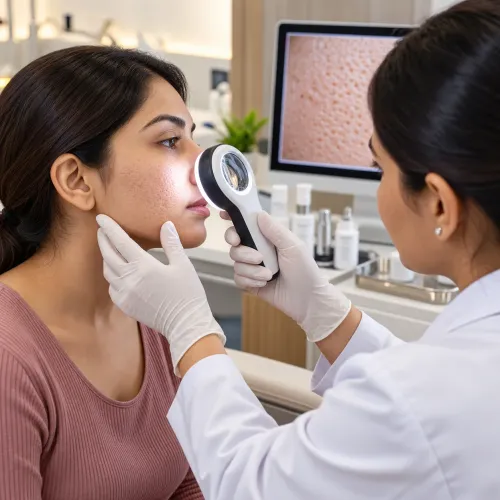
A scalp assessment may consider:
- Scaling or flaking
- Redness
- Itching
- Excessive oiliness
- Visible inflammation
- Localised areas of hair loss
- Overall thinning pattern
- Hair shaft characteristics
- Signs that suggest a particular scalp condition
These findings can provide clues about whether the concern primarily involves the scalp, the hair growth cycle, patterned thinning, or another process.
When Is Hair Fall Worth Evaluating?
Some degree of daily shedding is normal, and the number of hairs noticed can vary.
Evaluation becomes more useful when you notice a clear change from your usual pattern, visible thinning, widening of the parting, receding areas, patches of hair loss, persistent scalp symptoms, or prolonged shedding.
Sudden changes also deserve attention.
Why Shampoo Alone Has Limitations
Shampoo primarily cleans the hair and scalp. Medicated shampoos can have specific roles in selected scalp conditions, but ordinary cosmetic shampoos cannot be expected to correct every underlying cause of hair loss.
Repeatedly switching products may therefore delay appropriate evaluation.
The same caution applies to supplements. Taking multiple hair supplements without determining whether they are necessary is not the same as investigating persistent hair fall.
What Information Can Help During Consultation?
Before visiting, think about whether there have been recent changes such as:
- Significant illness
- Major stress
- Dietary changes
- Rapid weight changes
- New medicines
- Hair colouring or chemical procedures
- Tight hairstyles
- Changes in menstrual or hormonal patterns where relevant
- Family history of patterned hair thinning
Not every factor will be relevant, but the history helps build context.
Treatment Should Follow the Likely Cause
Once the scalp and hair-loss pattern have been assessed, the dermatologist can discuss what management is appropriate.
This may include scalp care, medical treatment, changes in haircare practices, investigations when indicated, or procedural options for selected patients.
There should not be an assumption that every person with hair fall needs the same therapy.
At SIYONA Skin Hair and Aesthetic Clinic, hair and scalp concerns can be evaluated from a dermatology and trichology perspective before an individualized plan is considered.
What Should You Ask the Provider?
For patients in Wagle Estate and other parts of Thane, Maharashtra, useful questions include:
- What pattern of hair loss do I appear to have?
- Is my scalp contributing to the problem?
- Do I need investigations?
- Which treatments are relevant to my situation?
- How long before response can reasonably be assessed?
- Will ongoing management be required?
Hair changes often take time to evaluate because hair growth itself occurs gradually.
The most useful starting point is therefore not finding the strongest hair product. It is determining whether the concern is primarily shedding, progressive thinning, a scalp disorder, hair-shaft damage, or another identifiable pattern.
That information gives scalp and hair treatment a much clearer direction.
Keywords